Would you like to visit a Fourth regional site closer to you?
How time flies!
It’s hard to believe that it’s already been a year since we shared our 2025 legislation report, but here we are again in 2026 with a host of new HR and Payroll legislative updates for the industry to navigate.
The new tax year brings with it a hike in National Minimum Wage (NMW) and National Living Wage (NLW) rates, continuing a multi-year trend of above inflation wage growth. While the increase is good news for workers, it could come at the cost of jobs in the sector with current forecasts suggesting a further 100,000 hospitality jobs could be on the chopping block as the cost of doing business increases. Labour remains the single largest variable cost for most operators.
The Government’s Employment Rights Act progressed through the house last year, though many of its sweeping day-one employment rights have been scaled back or delayed. The proposed introduction of day-one unfair dismissal rights are just one measure that will not come into force this year. Other changes, such as Statutory Sick Pay and certain leave entitlements will, however, take effect in 2026. For hospitality employers, keeping track of immediate compliance concerns and monitoring likely longer-term changes isn’t going to get any easier in 2026.
UK Hospitality CEO Allen Simpson summed this up well in discussion with the Fourth team during our webinar on the Autumn Budget, “The government has an unusually heavy legislative agenda, and we’ve already seen examples where measures are scaled back or delayed. Businesses are being asked to plan for change without certainty that everything proposed will actually come into force.”
You can continue to read the report on this webpage, or download a PDF version for free via the link above.
Alison is Fourth’s resident payroll expert and a Fellow of the Chartered Institute of Payroll Professionals, with over 20 years’ experience implementing workforce solutions for hospitality. Having spent many years as a payroll manager, she understands the daily challenges teams face. Alison now leads Fourth’s UK Human Capital Management product, developing HR and payroll solutions that support the evolving needs of hospitality operators.

The Government continues its drive to narrow the pay gap between age bands with new statutory National Minimum Wage (NMW) and National Living Wage (NLW) rates coming into effect from April 2026. The NMW for workers aged 21 and over will rise by 4.1% to £12.71 per hour, with increases of 8.5% and 6% respectively for those aged 18-20 and under 18s and apprentices.
For labour-intensive sectors like hospitality, an increase in headline rates is only half the story. Higher NMW has a knock-on effect on employer National Insurance Contributions (NIC), pension contributions, and holiday accrual, pushing the cost of employing staff above the NMW increase alone.
Meet Rowan. Rowan is a 21-year-old working full time at their local restaurant. From April 2026, the cost of hiring Rowan will increase by approx. £1352.52 a year.
HR and Payroll Teams:
Use Fourth’s Pay Rate tool to review
Use Fourth’s NMW payroll export to identify employees whose pay is under NMW
Ops Teams and Managers:
Contributions (NIC) thresholds remain unchanged for the 2026/27 tax year. The Upper Earnings Limit (UEL) is unchanged at £50,270.
Time & Attendance software does all the hard work for you, accurately capturing employee attendance, simplifying time-tracking, payroll accuracy, and labour planning.

April will see changes to the Lower Earnings Limit (LEL) increase from £125 to £129 a week. This is the amount an employee needs to earn per week to be eligible for provisions such as statutory maternity or paternity pay. In hospitality, it’s not uncommon for employees working variable hours to move above and below the threshold week-to-week, meaning entitlements change frequently, too.
Alongside this, statutory weekly pay rates will also go up, with all parental pay increasing from £187.18 to £194.32. Statutory sick pay is set to rise from £118.75 to £123.25.
Small Employer Relief (SER) rules mean eligible employers (those who paid £45,000 or less in Class 1 NIC in the previous tax year) can reclaim 100% of employees’ statutory payments, plus additional compensation. From April 2026, this additional compensation will jump from 8.5% to 9%. Operators that don’t qualify for SER can claim back 92% of the amount paid out.
HR and Payroll Teams:
Fourth’s platform will be updated in line with legislation ahead of April 2026
Ops Teams and Managers:
Employment reforms introduced in 2025 as part of the Employee Rights Act expand eligibility for statutory sick pay and give employees the right to take certain parental leave from their first day of employment.
From April 2026, Statutory Sick Pay (SSP) will be payable from the first day an employee is absent due to sickness, removing the current three-day waiting period.
At the same time, the Lower Earnings Limit (LEL) for SSP eligibility will be removed, extending the entitlement to lower-paid and casual workers who may not have qualified before.
Employees who earn less than the SSP rate (£123.25 a week) are entitled to 80% of their average weekly earnings, rather than the flat statutory amount. If new employees fall sick before they have sufficient earnings history, then employers will need to use their expected weekly earnings to calculate SSP.
Taken together, these changes significantly increase SSP coverage across hospitality workforces, particularly for staff working short or variable hours.
The new tax year also brings with it new rights around statutory leave entitlements, with paternity leave and unpaid parental leave becoming day-one rights.
While new employees are entitled to take these leaves straight away, they are not automatically eligible for statutory pay.
For family-related leave, statutory pay is still subject to the LEL and at least 26 weeks of continuous employment.
HR and Payroll Teams:
Ops Teams and Managers:
Fourth will automatically update payroll to ensure leave and pay is applied consistently
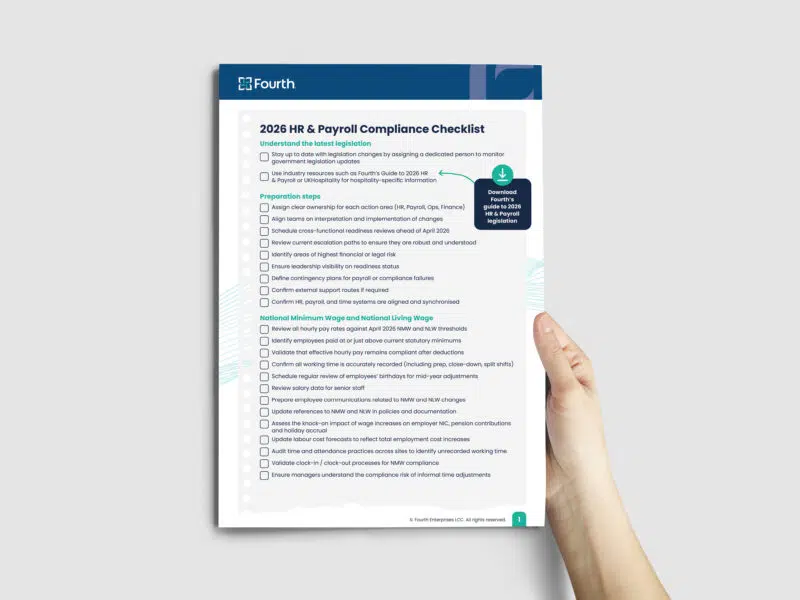
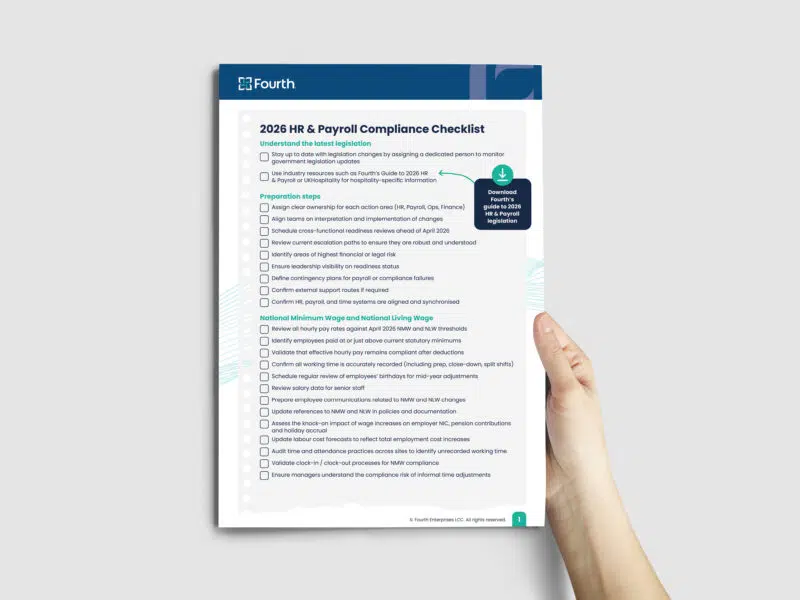
Getting ready for April 2026? This operator checklist summarises the practical actions HR, payroll, operations, and finance teams should take to prepare for upcoming legislation changes.
Payrolling Benefits in Kind (BIK) has been optional since 2016, and was expected to be mandatory from 2026. This has now been delayed until 2027.
Employers who opt in to payrolling benefits report them in real-time rather than annually.
This eliminates the need for year-end reporting for those benefits, resulting in more accurate tax codes.
Adding Benefits in Kind (BIK) to payroll could streamline the process for many operators, reducing the risk of non-compliance and preventing employees from receiving surprise tax bills at the end of the year.
While the process is optional and does require a hefty initial setup, including registering with HMRC, updating payroll systems, and communicating the change to employees, in the long term, it should reduce the number of employee tax code queries and improve cash flow predictability.
From April 2026, Fourth will add a new BIK service to its Payroll Bureau, to take away the initial set- up and ongoing admin burden so you can payroll benefits quickly and easily
Business Teams:
HR and Payroll Teams:
Ops Teams and Managers:
April 2026 is the earliest point at which payments for the Student Loan Repayment Plan 5 will start.
Introduced for students starting a qualifying course on or after August 2023, this loan repayment plan operates exactly as plans 1, 2 and 4, but has a lower repayment threshold and a longer payment term. Plan 5 borrowers pay 9% on yearly earnings over £25,000.
HR and Payroll Teams:
Fourth’s system will automatically update to include Student Loan Plan 5 from April 2026
Most of the updates outlined in this report are applicable across the UK. However, there are updates to parental bereavement leave and pay relevant only to employees and operators in Northern Ireland (NI).
As of April 2026, new legislation will introduce statutory parental bereavement leave and pay in NI. Under the new framework, bereavement leave becomes a day-one right and will cover cases of miscarriage, stillbirth, or child death.
While employees have the right to take leave from day one, eligibility criteria for statutory pay still apply and employees will only qualify if their employer makes Class 1 NIC on their behalf and pay is above LEL. This is a marked difference from the rest of the UK, where eligibility for parental bereavement pay requires 26 weeks of continuous employment.
HR and Payroll Teams:
Fourth’s system will automatically flag employees in NI
Ops Teams and Managers:
Getting ready for April 2026? This operator checklist summarises the practical actions HR, payroll, operations, and finance teams should take to prepare for upcoming legislation changes.
As well as new day-one rights, the Employment Rights Act also strengthens protections around reporting sexual harassment in the workplace. From April 2026, disclosures relating to sexual harassment must be treated as qualifying disclosures under whistleblowing legislation.
This means employees who raise concerns about sexual harassment will be protected from detriment, like reduced shifts, and unfair dismissal under whistleblowing law.
Employers already have a duty to take reasonable steps to prevent sexual harassment, but there is a risk in hospitality that this type of behaviour, particularly from customers, is “part of the job.” The extension of whistleblowing protection increases the legal risk if complaints are seen to be mishandled, or staff are perceived to be penalised for speaking up.
HR and Payroll Teams:
Ops Teams and Managers:
Legislation that won’t start in April, but operators should keep on their radar for 2026.
The Employment Rights Act (2025), previously the Employment Rights Bill, was described by the Government as the most significant reform of employment rights in a generation when it was first announced in October 2024. It was passed in late 2025, though not before undergoing several amendments.
Here’s what you need to know:
The proposal to introduce unfair dismissal protection from day one has been withdrawn in favour of a six-month qualifying period. This qualifying period is not expected to come into force until 2027, meaning there is no immediate change for operators beyond their existing obligations.
When the new protections do come into effect, reasons for automatic unfair dismissal are likely to remain the same.
Probationary periods will also still be relevant for managing performance and assessing suitability in early employment.
Reforms to zero-hours contracts and predictable working patterns are expected in later phases of the legislation, likely late 2026 or 2027.
Future reforms are expected to include a right for workers to request more predictable working patterns and may entitle them to compensation if shifts are cancelled or changed last minute. While these changes are not immediate compliance requirements, they are likely to have a significant operational impact for hospitality businesses, so they are definitely worth keeping an eye on.
Northern Ireland has an equivalent legislation currently in draft stage that’s likely to be presented to the Assembly in early 2026. Called the ‘Good Jobs Employment Rights Bill’, the details and timing of any resulting legislation is yet to be confirmed, but there are currently 50 proposed measures associated with it.
When eventually introduced, the changes are likely to differ from those in the UK’s Employment Rights Act, but there are similar sweeping proposals for zero and low-hours contracts, including:
In many ways, the changes taking effect in April are far less dramatic than we were initially expecting, but that doesn’t diminish them. The impact of the NMW increases, expanded statutory pay eligibility, and new day-one rights are cumulative and will add to the cost and complexity of HR and operations.
As highlighted by UKHospitality’s Chair, Kate Nicholls, “Increases to minimum wage rates are yet another cost for hospitality businesses to balance, at a time when they are already being taxed out.”
The reprieve offered by the phased implementation of rights proposed in the Employment Rights Act will be short-lived, and we now have the additional complications associated with that phased introduction to contend with.
For most operators, the best way to meet April 2026 will be to get the basics right. Focus on accurate pay calculations, updating payroll systems, ensuring policies are clear, and the handling of employee absences and leave is consistent.
Getting ready for April 2026? This operator checklist summarises the practical actions HR, payroll, operations, and finance teams should take to prepare for upcoming legislation changes.
As ever, Fourth will continue to monitor legislative developments and update our software and services in line with incoming legislation, making compliance as seamless as possible for our customers.
Our experts will keep sharing updates on incoming legislation as further changes are confirmed, just one of the many ways we’re here for our customers.
Fourth’s PAS Accredited Payroll Bureau provides fully managed payroll services designed specifically for hospitality operators, processing over 400,000 payslips a month. Supported by a dedicated team of payroll specialists based in Macclesfield near Manchester, the Bureau serves as a dedicated payroll partner, helping ensure you’re on track to grow your business.
Give us a call today +44 (0) 207 534 3700, or click the button below
Save time, reduce costs, and increase profitability with Fourth’s intelligent solutions.